Last updated: · Reviewed by Joachim Louw, CEng MIEI
StructuralEngineer.ie carries out pyrite assessments to I.S. 398-1:2013 for homes in Dublin, Meath, Kildare and the surrounding counties. Joachim Louw (CEng MIEI) inspects the house for the damage pattern pyrite heave produces, carries out the building condition assessment, records the damage condition rating, and advises whether sampling and testing of the hardcore under the floor is justified. The Government's Pyrite Panel identified affected estates in Dublin City, Fingal, Kildare, Meath and Offaly, and the remediation scheme was later extended to Dún Laoghaire-Rathdown, South Dublin and Limerick.
Pyrite doesn't cause every crack in a 2000s house. The assessment exists to tell the difference, and to give you the documentation the Pyrite Remediation Scheme and insurers ask for.
What happens on the first visit
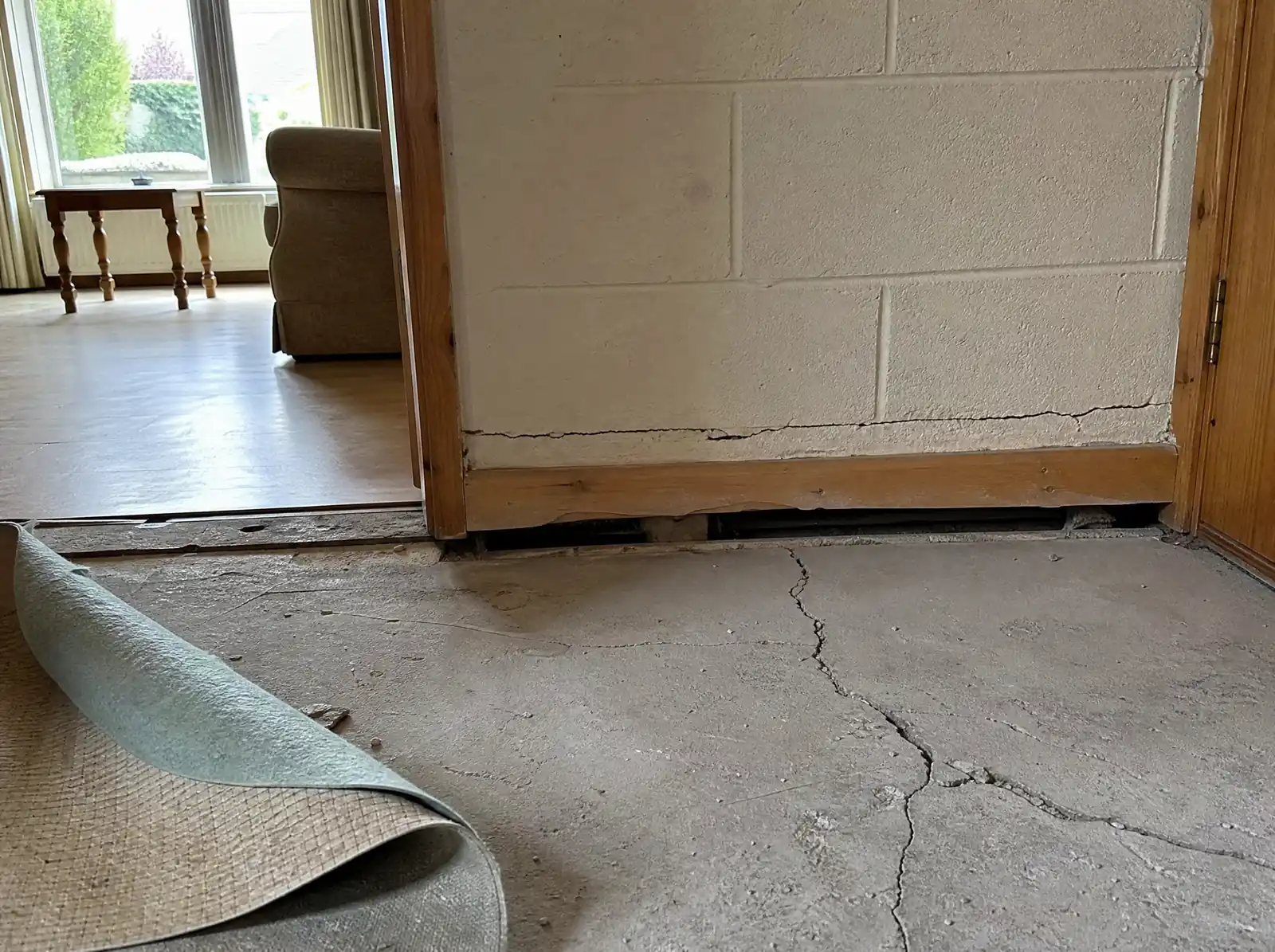
The building condition assessment looks for the specific damage pyrite heave produces: the ground-floor slab lifting and cracking, internal walls cracking just above floor level, doors binding, and external walls pushed out at DPC level. These are recorded systematically, and floor levels are measured where needed.
- Measure ground-floor levels across rooms to detect slab lift
- Record cracking in floor slabs and at the base of internal walls
- Check doors and frames for binding and distortion
- Inspect external walls at DPC level for outward displacement
- Review construction date, estate history and any previous tests
- Decide whether sampling and laboratory testing are warranted
How I.S. 398-1 works
I.S. 398-1:2013 (Reactive pyrite in sub-floor hardcore material, Part 1: Testing and categorisation protocol) sets out a staged approach. First a building condition assessment produces a damage condition rating. Where the damage and other evidence suggest pyrite, the hardcore is sampled through the floor and tested in a laboratory for its pyrite and sulfur content and its potential to swell.
Combining the damage rating with the test results gives the dwelling's category, from no damage and no reactive pyrite through to significant damage with reactive pyrite. That category is what the remediation scheme and lenders work from.
What pyrite heave looks like, and what it doesn't
Pyrite in the hardcore oxidises and forms sulfate minerals that take up more volume, so the fill expands and pushes the slab up. The damage starts at floor level: cracks in the slab, cracks at the bottom of internal block walls, and skirting gaps opening. External walls can be pushed out at the slab edge.
Cracks high on walls, around windows, or stepped through external blockwork usually point to other causes, such as shrinkage, settlement or subsidence. That is why the assessment comes before sampling.
The Pyrite Remediation Scheme
The Pyrite Remediation Scheme, run by the Pyrite Resolution Board with the Housing Agency, is a scheme of last resort for homeowners with significant pyrite damage and no other practical route to redress. Eligibility depends on the dwelling's location, the damage being established under I.S. 398-1, and other conditions. Check the current rules with the Pyrite Resolution Board before relying on the scheme. Over 2,000 homes had been remediated by 2020.
What's included
- Building condition assessment to I.S. 398-1
- Damage condition rating
- Floor level survey where needed
- Review of construction history and previous reports
- Clear advice on whether sampling is justified
- Sampling and testing coordination if needed
- Written report with categorisation
- Guidance on the remediation scheme and next steps
Fixed fee confirmed in writing before the visit.
Straight to lab tests, a general survey, or an I.S. 398-1 assessment
Order matters. Here's what each route gets you.
| Check | Lab tests first | General survey | I.S. 398-1 assessment |
|---|---|---|---|
| Damage pattern assessed first | No | partial | Yes |
| Damage condition rating recorded | No | No | Yes |
| Sampling only when justified | No | n/a | Yes |
| Categorisation the scheme recognises | partial | No | Yes |