Last updated: · Reviewed by Joachim Louw, CEng MIEI
StructuralEngineer.ie carries out subsidence surveys for homeowners across Dublin, Kildare, Meath and Wicklow. A Chartered Engineer, Joachim Louw (CEng MIEI), investigates the cracking and the ground, finds the cause (clay shrinkage, trees, leaking drains, soft ground or heave), monitors movement where needed, and writes a report you can put in front of your insurer. Where repair is needed, he designs it, from drain repairs to underpinning.
Irish guides put an initial subsidence investigation and report at about €600–€1,200, with level monitoring and site investigation on top where the cause isn't clear. Your fee is fixed in writing before the visit.
What happens on the first visit
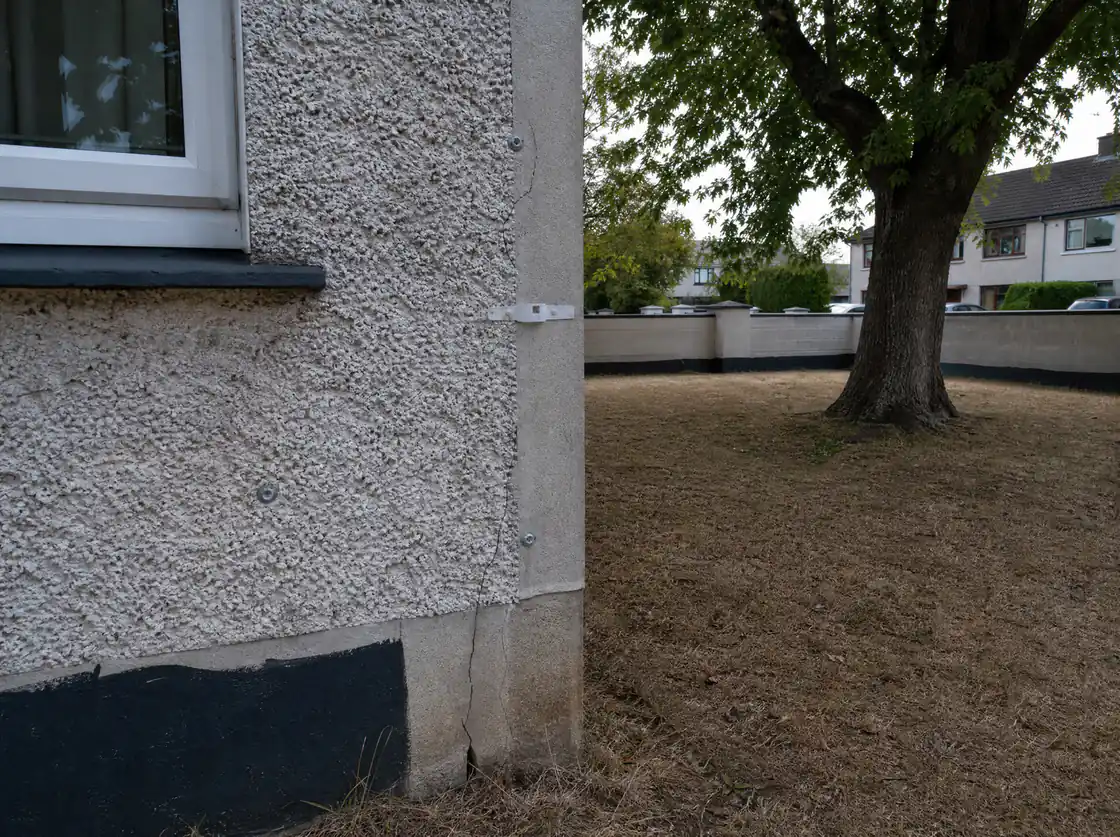
The first visit establishes whether the damage pattern fits subsidence at all. Subsidence is downward movement of the ground under the foundations, and it leaves a recognisable pattern: tapering, stepped cracks, often at corners and openings, opening in dry weather. Many reported 'subsidence' cases turn out to be something else.
- Map and measure all cracking inside and out, and note any taper
- Check floor levels and door frames for tilt
- Record trees and large shrubs, with species, height and distance from the house
- Look at drains, gullies and downpipes near the cracked area for leaks
- Ask about timing: when the cracks appeared, and whether they change with the seasons
- Recommend trial pits, CCTV drain surveys or level monitoring where needed
What causes subsidence in the Dublin area
Clay shrinkage is the most common cause. Much of County Dublin, Meath and Kildare sits on clay-rich glacial till. In long dry spells, and where tree roots draw moisture out, the clay shrinks and the foundations above it drop. Damage shows in late summer and partly closes in winter.
Leaking drains wash fine material out of the ground or soften it, so the foundation over the leak drops. Repairing the drain is often most of the cure.
Heave is the opposite problem: ground swelling after a large tree near the house is felled, or pyrite in hardcore under the floor expanding. It is easily mistaken for subsidence and repaired the wrong way.
Monitoring, site investigation and underpinning
If the cause isn't clear from the first visit, level monitoring points are fixed to the walls and read over several months, typically through a summer and winter, to show whether the house is moving and in which direction. Trial pits expose the foundation and the soil, and samples can be tested for plasticity. CCTV drain surveys find leaks.
Most subsidence is cured by removing the cause: repairing drains, or managing trees with arboricultural advice, never felling on clay without considering heave. Underpinning, which deepens or replaces foundations with mass concrete or mini-piles, is for cases where the movement will continue otherwise. It is designed to I.S. EN 1997-1.
Subsidence insurance claims
Most Irish home policies cover subsidence, heave and landslip, usually with a higher subsidence excess, often €1,000–€2,500. Tell the insurer early. Their engineer will investigate and the claim typically runs report, then monitoring, then repair, with the excess deducted from the settlement.
Claims are often disputed over definitions. Policies usually exclude 'settlement' of new structures and damage from defective workmanship. An independent engineer's report that records the pattern, the timing and the cause gives you an evidence base. If a dispute isn't resolved, the Financial Services and Pensions Ombudsman publishes decisions on subsidence cases.
What's included
- Inspection by a Chartered Engineer
- Crack mapping and damage categorisation
- Tree, drain and ground assessment
- Trial pit and drain survey recommendations
- Level monitoring programme where needed
- Written cause report for your insurer
- Liaison with the insurer's engineer
- Repair or underpinning design if needed
Typical market range: €600–€1,200 (subsidence investigation; monitoring and trial pits extra). Source: Banrach subsidence cost guide, 2026. Fixed fee confirmed in writing before the visit.
Insurer's engineer only, a builder's opinion or your own engineer
The insurer's engineer works for the insurer. Here is what each route leaves you with.
| Check | Builder's opinion | Insurer's engineer only | Your own Chartered Engineer |
|---|---|---|---|
| Cause investigated with evidence | No | Yes | Yes |
| Works for you, not the insurer | Yes | No | Yes |
| Monitoring and trial pits specified | No | Yes | Yes |
| Independent report to compare findings | No | No | Yes |
| Repair designed for the cause | sometimes | Yes | Yes |