Last updated: · Reviewed by Joachim Louw, CEng MIEI
StructuralEngineer.ie provides steel connection design for steel fabricators, contractors and engineers across Ireland. Joachim Louw (CEng MIEI) designs and checks connections to I.S. EN 1993-1-8 using the member forces from the main design: beam-to-column and beam-to-beam end plates and fin plates, column base plates and holding-down bolts, splices, and bracing connections. You get calculations and connection details your shop can detail from.
Connection design is commonly left to the fabricator under the contract, but many smaller fabricators don't have an engineer in-house. This service fills that gap, from a single goalpost frame for a house extension to a small commercial frame.
What happens on the first visit
Connection design usually starts from drawings, not a site visit. Send the general arrangement, the member sizes and the design forces or reactions from the main engineer, plus any shop preferences for plate thickness, bolt grade or weld type. Where forces haven't been given, they can be derived from the main design, or agreed with the main engineer.
- General arrangement drawings and member schedule
- Design forces or reactions at each connection type
- Steel grade (S275 or S355) and corrosion protection
- Shop preferences: bolt grade, plate stock, weld procedures
- Site constraints: erection sequence, access, tolerances
- Programme and fabrication slot
What gets designed
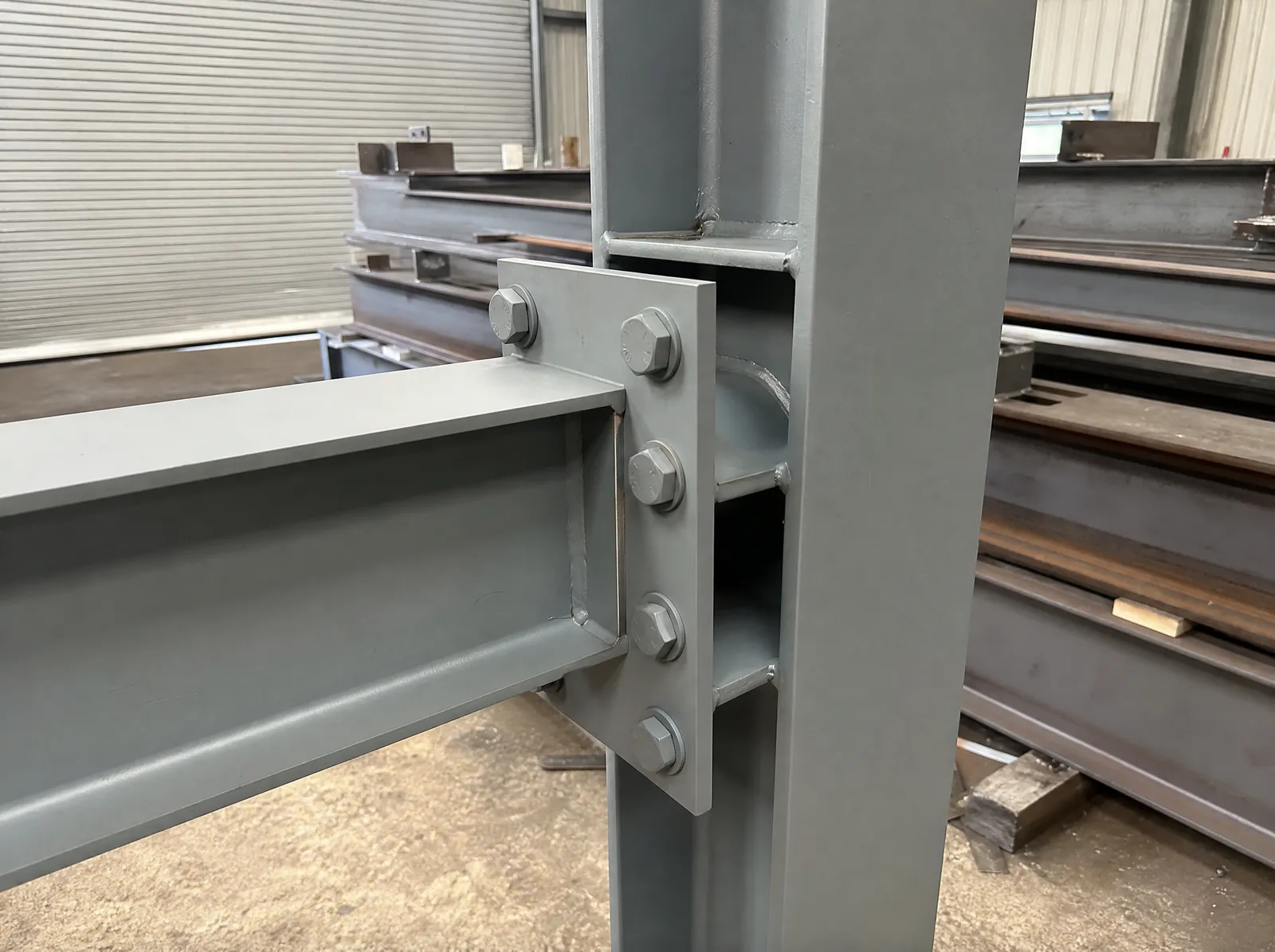
Simple connections: fin plates, flexible end plates and web cleats, checked for shear, bolt bearing, block tearing and weld capacity, with enough rotation capacity for the simple-joint assumption.
Moment connections: extended end plates and haunches for portal frames and goalposts, checked by the component method in I.S. EN 1993-1-8. Base plates and holding-down bolts are checked for bearing on the grout and concrete, plate bending and anchorage. Splices and bracing connections are designed for the forces and any reversal.
Deliverables and coordination
You get calculations for each connection type with a summary schedule, and sketches showing plate sizes, bolt numbers, grades and weld sizes for your detailer. Queries from the main engineer or the checker are answered as part of the fee. Where a connection forces a member change, it is flagged before you order steel.
What's included
- Review of GA drawings and member forces
- Simple connection design (fin plates, end plates, cleats)
- Moment connection design (end plates, haunches)
- Base plates and holding-down bolts
- Splices and bracing connections
- Connection schedule and detail sketches
- Responses to checker queries
- Calculations signed by a Chartered Engineer
Fixed fee confirmed in writing before the visit.
Standard tables, software output only, or engineered connections
What arrives on the checker's desk.
| Check | Standard tables only | Software output only | Engineered and signed |
|---|---|---|---|
| Checked against the actual forces | No | Yes | Yes |
| Shop preferences built in | No | sometimes | Yes |
| Engineer answers checker queries | No | No | Yes |
| Signed by a Chartered Engineer | No | No | Yes |